
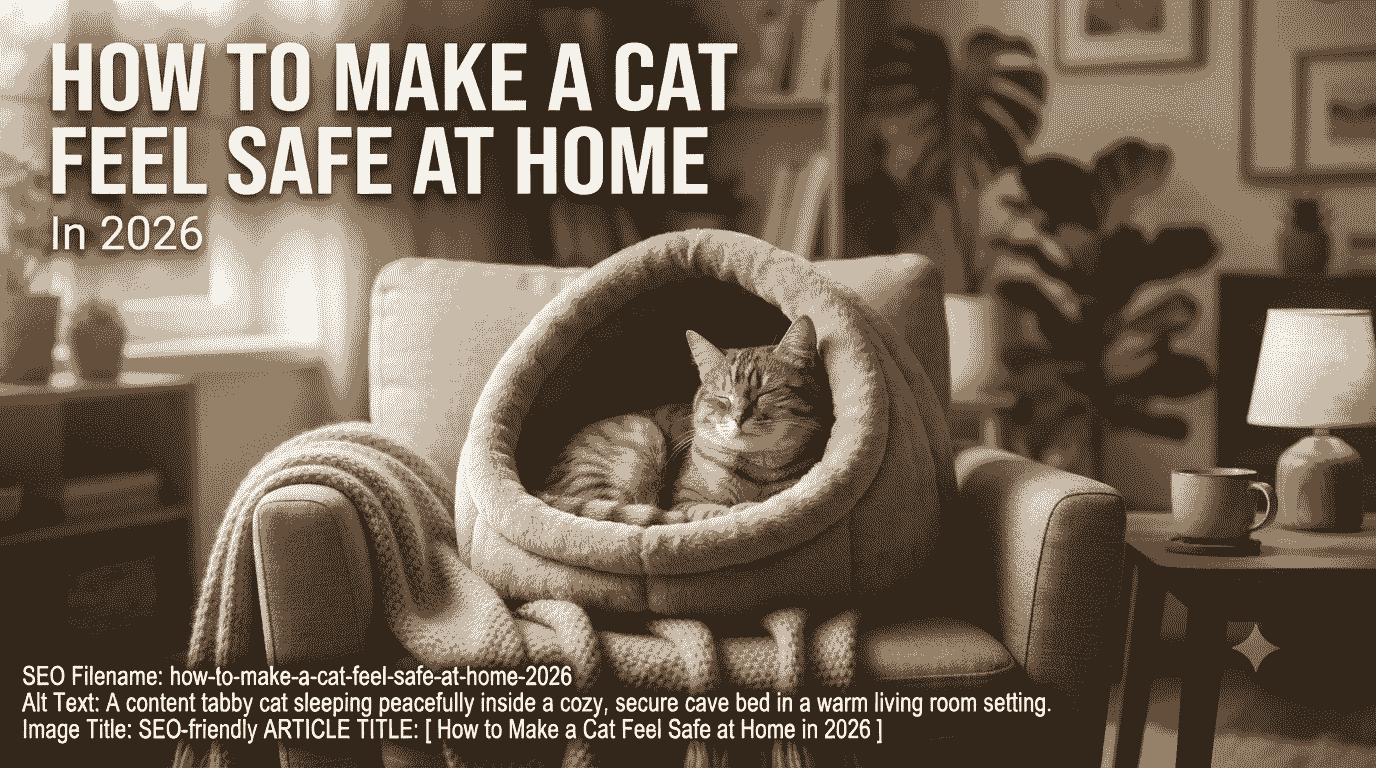
Cat seems tense even in a home it’s lived in for years? Here’s what actually makes a cat feel safe, not just comfortable.
A cat can live somewhere for years and still not feel entirely secure in it. That’s a strange thing to sit with, but it’s true — the difference between a cat that’s merely present in a space and a cat that genuinely feels safe there is real, and it’s not always obvious from the outside. A cat that flinches at sudden noises, avoids certain rooms, or spends most of its time in one elevated spot isn’t necessarily traumatized. It might just be a cat whose environment hasn’t quite given it what actual security requires.
Security, for a cat, isn’t about affection or comfort in the way people usually think about it. It’s about control — specifically, control over its own space, its own escape routes, and its own ability to observe before engaging. Most of what makes a home feel safe to a cat comes down to whether that control genuinely exists, not how soft the bed is or how many toys are scattered around.
Vertical Space Changes Everything
Cats are ambush predators by instinct, and height gives a survival advantage that’s deeply wired in even for a cat that’s never hunted anything more dangerous than a laser pointer. A cat perched on top of a cat tree, a bookshelf, or a windowsill isn’t just enjoying a nice view — it’s positioned somewhere it can observe the whole room, assess anything approaching, and retreat if needed.
Homes without enough vertical options tend to leave cats feeling more exposed, especially in multi-pet or high-traffic households. Adding shelving, a tall cat tree near a window, or simply clearing the top of a bookcase gives a cat genuine strategic options rather than forcing it to feel safe only in a closet or under furniture, which technically works but isn’t nearly as good for actual quality of life.
Predictable Routine Does More Than People Expect
A cat that knows roughly when feeding happens, when the household gets quiet, when a particular door usually opens, has fewer unknowns to stay alert for. Unpredictability — feeding at random times, a chaotic schedule, inconsistent access to rooms — keeps a cat in a low-grade state of vigilance that never fully resolves into rest.
This doesn’t mean a rigid schedule down to the minute. It means enough general consistency that the cat’s nervous system can actually relax between events instead of treating every sound or movement as potentially significant.
Multiple Escape Routes, Especially in Multi-Pet Homes
A cat that feels cornered, even briefly, tends to remember that specific spot as unsafe going forward. Furniture arrangements that create dead ends — a food bowl tucked into a corner with only one way in and out, a litter box in a small closet with the door usually shut most of the way — quietly undermine security even when nothing bad has actually happened there yet.
In homes with dogs or multiple cats, this matters even more. A resource — food, water, a favorite resting spot — that can only be reached or left through one narrow path creates a chokepoint a more assertive animal can control, intentionally or not, which keeps the more cautious cat in a state of low-level stress around that specific area of the home.
Scent Marking Is Security Work, Not Just Habit
Cheek rubbing against furniture corners, doorframes, and people’s legs deposits pheromones from scent glands concentrated around the face — and this is functionally the cat marking territory as known and safe, not just an affectionate habit. A home saturated with a cat’s own scent registers as more secure to the cat than one that’s been recently cleaned, rearranged, or otherwise disrupted in ways that wipe out that scent layer.
This is part of why cats sometimes seem unsettled after a deep clean, new furniture, or a home renovation — not because anything’s wrong exactly, but because a meaningful layer of environmental information the cat relies on has been temporarily erased, and it takes time to rebuild.
Hiding Spots Aren’t a Problem to Fix
A tendency to see a cat hiding as something concerning, something to coax the cat out of, misreads what’s actually happening. Access to a genuinely private, enclosed space — a covered bed, the inside of a closet, a box with high sides — is a legitimate security resource, not a sign something’s wrong. Cats that have reliable access to a hiding spot they control tend to show more confidence exploring open areas of the home, not less, because the retreat option is always there if needed.
Removing hiding spots to “encourage” more social behavior tends to backfire, increasing overall stress rather than the intended increase in visible confidence.
Loud, Sudden Sounds Do More Damage to Security Than People Realize
A single startling event — a dropped pan, a vacuum turned on unexpectedly, a loud argument — can shift how safe a specific room feels to a cat for a surprisingly long time afterward, sometimes weeks. This isn’t the cat being dramatic. Sound processing in cats is considerably more sensitive than in humans, and a sudden loud noise registers as a genuine threat signal, not just an unpleasant sound.
Where practical, giving a cat advance warning — talking before starting a vacuum, closing a door to a room before a loud task rather than doing it with the cat present — reduces the accumulation of these startling moments that, collectively, keep a home feeling less secure than it otherwise would.
The Slow Blink Is a Two-Way Signal, Worth Using Deliberately
A slow blink from a cat toward a person is a documented signal of comfort and trust, and returning it — making eye contact, blinking slowly and deliberately back — genuinely communicates safety in a way the cat registers, rather than being a cute but meaningless gesture. This is one of the few pieces of common cat advice that holds up specifically as cross-species communication rather than projection.
Practiced consistently, especially with a cat that’s naturally more anxious or reserved, this small exchange builds toward a sense that the person themselves is part of what makes the space safe, not just a source of food and unpredictable interaction.
Multi-Cat Households Need Resource Duplication, Not Just More Resources
The general guidance of one litter box per cat plus one extra, and multiple separated feeding stations, exists specifically for security reasons, not convenience. A single shared resource, even with enough total food or litter capacity, creates competition and forces cats to negotiate access in a way that undermines the sense of control that actual security depends on.
Spreading resources across different rooms, not just different corners of the same room, matters more than most multi-cat households initially realize — physical distance between resource points reduces the sense of being watched or guarded by another cat while trying to eat or use the litter box.
What Genuine Security Actually Looks Like
Not necessarily constant affection or lap time — some cats are naturally more independent regardless of how secure they feel. The more reliable signs: relaxed body language throughout the home rather than only in one safe spot, willingness to sleep in open, exposed areas rather than only hidden ones, normal exploratory behavior, and a general lack of flinching or hypervigilance at ordinary household sounds and movement.
A cat that feels safe isn’t necessarily a cat that seeks out more interaction. It’s a cat whose whole environment reads, to its own instincts, as somewhere it doesn’t need to stay on guard.
FAQ
How do I know if my cat doesn’t feel safe at home?
Signs include avoiding certain rooms, spending most of the day in one hidden or elevated spot, flinching at ordinary sounds, and reluctance to sleep in open, exposed areas of the home.
Do hiding spots mean something is wrong with my cat?
No. A reliable, enclosed hiding spot the cat can retreat to on its own terms is a legitimate security resource. Cats with access to one often explore open spaces more confidently, not less.
Why does vertical space matter for a cat’s sense of safety?
Height lets a cat observe its surroundings and assess potential threats from a safer vantage point, which is instinctively reassuring even in a home with no actual danger present.
How many litter boxes does a multi-cat household need for security?
One per cat plus one extra, spread across different rooms rather than clustered together, to reduce competition and the sense of being watched while using a shared resource.
Does returning a cat’s slow blink actually mean anything?
Yes. A slow blink is a documented trust signal in cats, and returning it communicates safety in a way the cat genuinely registers, rather than being a purely symbolic gesture.