
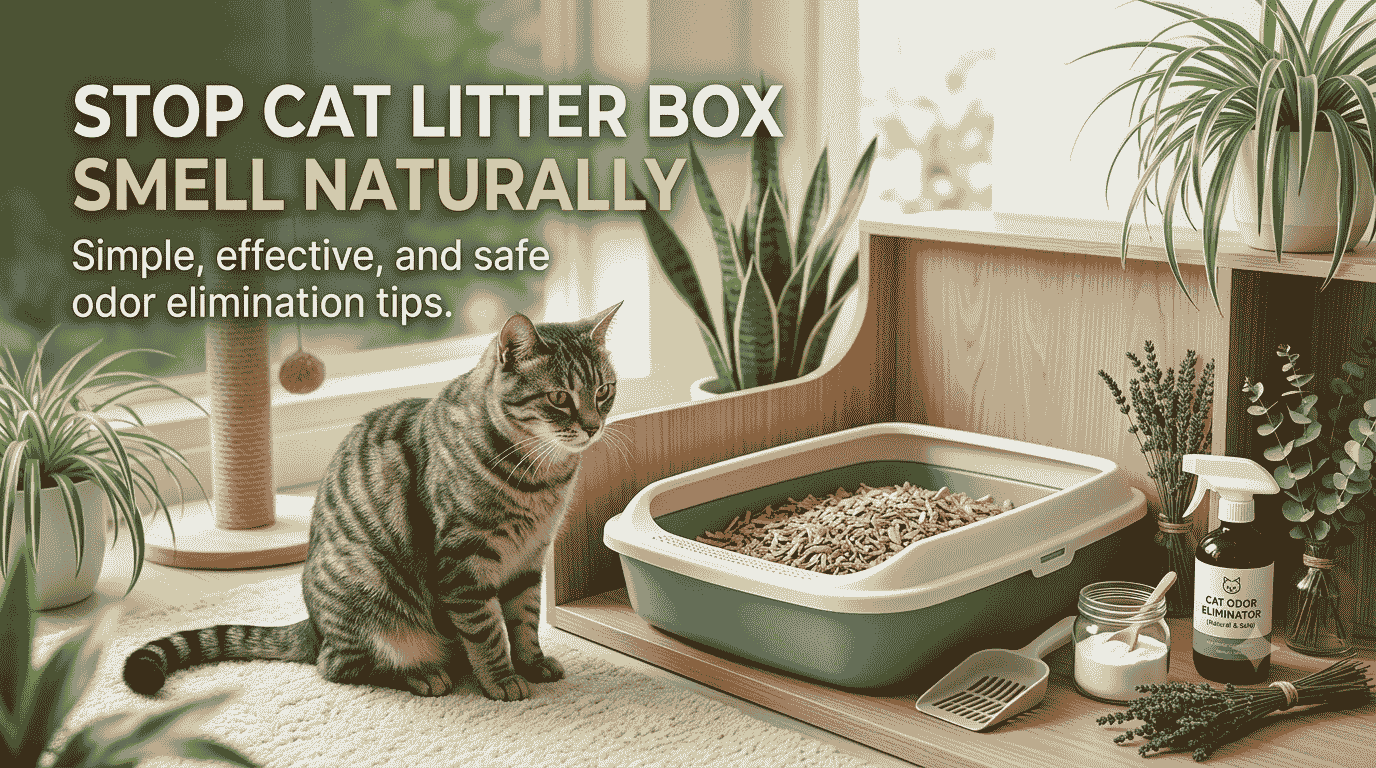
Tired of walking into a wall of litter box smell? Here’s what actually stops it naturally — no sprays, no fake fixes, just what works.
You smell it before you see it. You walk past the hallway, past the laundry room, past wherever the box lives, and there it is — that specific sour ammonia punch that makes you hold your breath for three seconds without meaning to. Your cat doesn’t smell it that way. You do. Every single time.
That gap — between what your nose registers and what your cat has fully tuned out — is basically the whole problem. Cats aren’t trying to stink up your apartment. Their litter habits are doing exactly what evolution designed them to do. The smell is a byproduct of chemistry, airflow, and timing, and once you understand those three things, you can actually get ahead of it instead of just reacting to it with a can of aerosol “fresh linen” spray that just adds a second smell on top of the first one.
Here’s what actually moves the needle — the natural, non-toxic, doesn’t-involve-perfume-bombing-your-hallway version.
Why Litter Box Smell Gets Bad So Fast
Cat urine smell isn’t really one smell. It starts out mild, almost neutral, and then bacteria go to work on the urea in it and break it down into ammonia. That’s the sharp, eye-watering part. Give it another day or two, and the bacteria produce mercaptans too — the same compound family that makes skunk spray so distinctive. That’s the layer that makes a two-day-old litter box smell fundamentally worse than a same-day one, not just “more of the same.”
Which means the single biggest lever isn’t a product. It’s time. A box scooped twice a day rarely smells like anything from more than a foot away. A box scooped every other day smells like a chemistry experiment gone wrong by the second afternoon.
The Scooping Rhythm Nobody Wants to Hear
Twice daily. Not once. Twice.
I know — that sounds like a lot until you realize it takes maybe 45 seconds each time if the box is set up right. Morning, before coffee, and again in the evening. Cats who use the box and encounter old waste in it will sometimes just… go somewhere else instead. A rug corner. A closet. A shower drain. So the smell problem and the “why did my cat suddenly stop using the box” problem are often the exact same root cause wearing two different outfits.
A full dump-and-reset of the litter — not just scooping, actually replacing everything — should happen every one to two weeks for clumping litter, more often for non-clumping.
Baking Soda Actually Works (But Not the Way People Use It)
Most people sprinkle a thin dusting of baking soda on top of the litter and call it done. That barely touches the ammonia sitting in the clumps underneath.
What actually works: mix baking soda directly into the litter at the bottom of the box before you add the top layer, roughly a quarter cup per standard box, then a lighter dusting mixed through the top inch too. Baking soda neutralizes acidic odor compounds instead of masking them, which is the entire difference between “smells better” and “still smells bad but now also smells like fake lavender.”
Activated Charcoal Litter Liners or Additives
Activated charcoal has a genuinely enormous surface area at a microscopic level, which means it physically traps odor molecules instead of covering them up. Some litters come with charcoal already mixed in. If yours doesn’t, a charcoal filter pad underneath the box — the same style used in air purifiers — pulls a surprising amount of the smell out of circulation before it ever reaches your hallway.
This is the one upgrade that people notice within a day and then ask why nobody told them sooner.
The Litter Type Matters More Than the Brand
Clumping clay litter, unscented, tends to outperform almost everything else for pure odor control because it isolates urine into a tight clump instead of letting it spread through the whole tray. Scented litters are, counterintuitively, often worse — a lot of cats find the perfume genuinely off-putting and will avoid the box more, which circles right back to the “old waste sitting there longer” problem.
Crystal litter and pine litter both have real fans and real odor-control ability, but they behave differently and switching cold turkey can spook a cat that’s used to clay. If you’re switching, mix the new litter in gradually over a week or two rather than dumping the whole box out one day.
Box Placement Is Doing More Than You Think
A box tucked into a closet with the door mostly shut traps ammonia in a tiny, low-airflow space — which is exactly the environment where smell builds fastest. A box near an open window, a vent, or even just a room with a ceiling fan running clears odor compounds out of the air before they concentrate.
Covered boxes make this worse, not better, even though they look tidier. The cover traps the smell right where your cat’s face is, and right where it hits you the second you lift the lid.
Enzymatic Cleaners for the Box Itself
Plastic litter boxes develop microscopic scratches over time, and bacteria colonize those scratches the way bacteria colonize anything porous. Soap and water alone won’t fully clear that out. Enzymatic cleaner — the same category used for pet stain removal on carpet — actually breaks down the organic residue at a molecular level rather than just rinsing the surface.
Full wash, enzymatic cleaner, complete dry before new litter goes back in — do this at every full litter change, not just when it starts looking obviously grimy. Boxes older than a year or two, especially ones that have absorbed odor for a long time, are sometimes cheaper to just replace than to keep deep-cleaning.
Ventilation Beats Every Spray on the Market
This is the part people skip because it feels too simple to be the answer, but a small fan running near — not pointed directly at — the litter area does more real odor work than most commercial sprays combined. Moving air prevents ammonia from pooling in one spot long enough to become the smell that hits you at the doorway.
If the box lives somewhere with zero natural airflow, a small HEPA air purifier with a carbon filter stage nearby handles what the fan can’t.
How Many Boxes You Actually Need
The standard guidance is one box per cat, plus one extra. Two cats, three boxes. This isn’t really about odor directly — it’s about distributing waste across more surface area so no single box gets hit hard enough, fast enough, to overwhelm whatever odor control you’ve set up. A single box serving two cats is doing double the work in the same square footage, and it shows.
What Doesn’t Actually Work
Scented sprays and plug-in air fresheners near the box mask the smell for a few minutes and then blend with it into something arguably worse. Vinegar poured directly into litter can react with ammonia in ways that irritate a cat’s respiratory system — useful for cleaning the empty box, not for treating litter in use. Essential oils, especially anything citrus or tea-tree based, are genuinely unsafe for cats in concentrated or diffused form and shouldn’t go anywhere near the litter area.
A Realistic Routine That Actually Holds
Morning scoop. Evening scoop. Baking soda mixed through at every full change. Full change and enzymatic wash every one to two weeks. A fan or purifier running nearby. Litter tucked somewhere with actual airflow, not sealed into a closet. That’s it — no fifteen-step plan, no subscription odor service, no reformulating your whole apartment around one small box.
Most people who complain their house “always smells like cat” are one or two steps away from a house that doesn’t, and almost never because they need a better product. Usually it’s timing, airflow, or a box that’s been quietly overdue for a real wash for longer than anyone wants to admit.
FAQ
How often should I scoop the litter box to stop the smell?
Twice a day is the real answer. Once a day lets ammonia build past the point where masking products can keep up.
Does baking soda actually get rid of litter box smell?
Yes, but only if it’s mixed through the litter, not just sprinkled on top. A quarter cup mixed in at the bottom, plus a light layer through the top inch, neutralizes odor rather than covering it.
Is charcoal litter worth it?
For most households dealing with persistent smell, yes. Activated charcoal physically traps odor molecules rather than masking them, and the difference is often noticeable within a day.
Should the litter box be covered?
Generally no. Covered boxes trap ammonia in a small space right where the smell is strongest, which usually makes the problem worse rather than better.
How many litter boxes do I need for multiple cats?
One per cat plus one extra. For two cats, that’s three boxes, spread across different areas if possible.
Do air fresheners or sprays help with litter smell?
Not really. They add a second smell on top of the first rather than removing the source, and the combination is often worse than the original odor alone.